Made-to-measure clothing is adjusted from an existing pattern. Semi-bespoke and bespoke both start from a pattern made just for you, from your own measurements, proportions and posture. Bespoke adds a muslin fitting before the cloth is cut and is made entirely by hand.
The terms get used loosely, and as Christian Gardner puts it, “people just don’t know the difference.” Here is how each one works at Scarborough.
What is a bespoke suit?
A bespoke suit is cut from a pattern drafted for one person and shaped over several fittings, with most of the work done by hand. At Scarborough, that means three fittings, a muslin test garment before your cloth is cut, and a suit made entirely by hand.
The word itself is not protected. In 2008, the UK's Advertising Standards Authority ruled that a tailor could call suits bespoke if they were made to the customer's measurements and specifications, even if they were not handmade from a pattern cut from scratch. Savile Row holds itself to a stricter standard. The Savile Row Bespoke Association defines a bespoke suit as one cut from a pattern made for that customer, with a series of fittings and at least 50 hours of handwork.
Everywhere else, the word means what the tailor using it says it means. That is why the process matters more than the label.
Made-to-measure
Made-to-measure starts from a pattern that already exists, then alters it to your measurements. It works well for pieces with a more forgiving fit. At Scarborough, Christian uses made-to-measure for casual wear such as knitwear and bomber jackets.
Semi-bespoke
Semi-bespoke starts from an individual pattern made from your measurements, proportions and posture. Christian measures you and works out the design at your first appointment, and you return for a fitting once the finished garment arrives.
Every semi-bespoke jacket is fully canvassed and hand finished. The edges of the lapels, pockets and vents are pick-stitched by hand, and the buttonholes and buttons are sewn by hand.
Semi-bespoke suits begin at $2,200 and take about six to eight weeks. It suits someone who wants a beautiful, individually patterned garment without the extra time bespoke takes.
Bespoke
Bespoke uses the same individual pattern, with three fittings instead of two:
Measurements: Christian takes your measurements and works out the design.
Muslin fitting: you try on a test garment made in muslin. Christian checks the fit, balance and proportions and refines the pattern before your cloth is cut.
Final fitting: you try on the finished garment, and Christian makes any last adjustments.
A bespoke garment is made entirely by hand. The lapels are pad-stitched by hand, the sleeves and collar are set by hand, and the shoulder, pocket openings, hem and vents are all handwork.
Bespoke suits begin at $3,200 and take about eight to ten weeks. “Bespoke is for an elevated experience and a more refined fit,” Christian says, “for the gentleman who has more time to create a beautiful garment.”
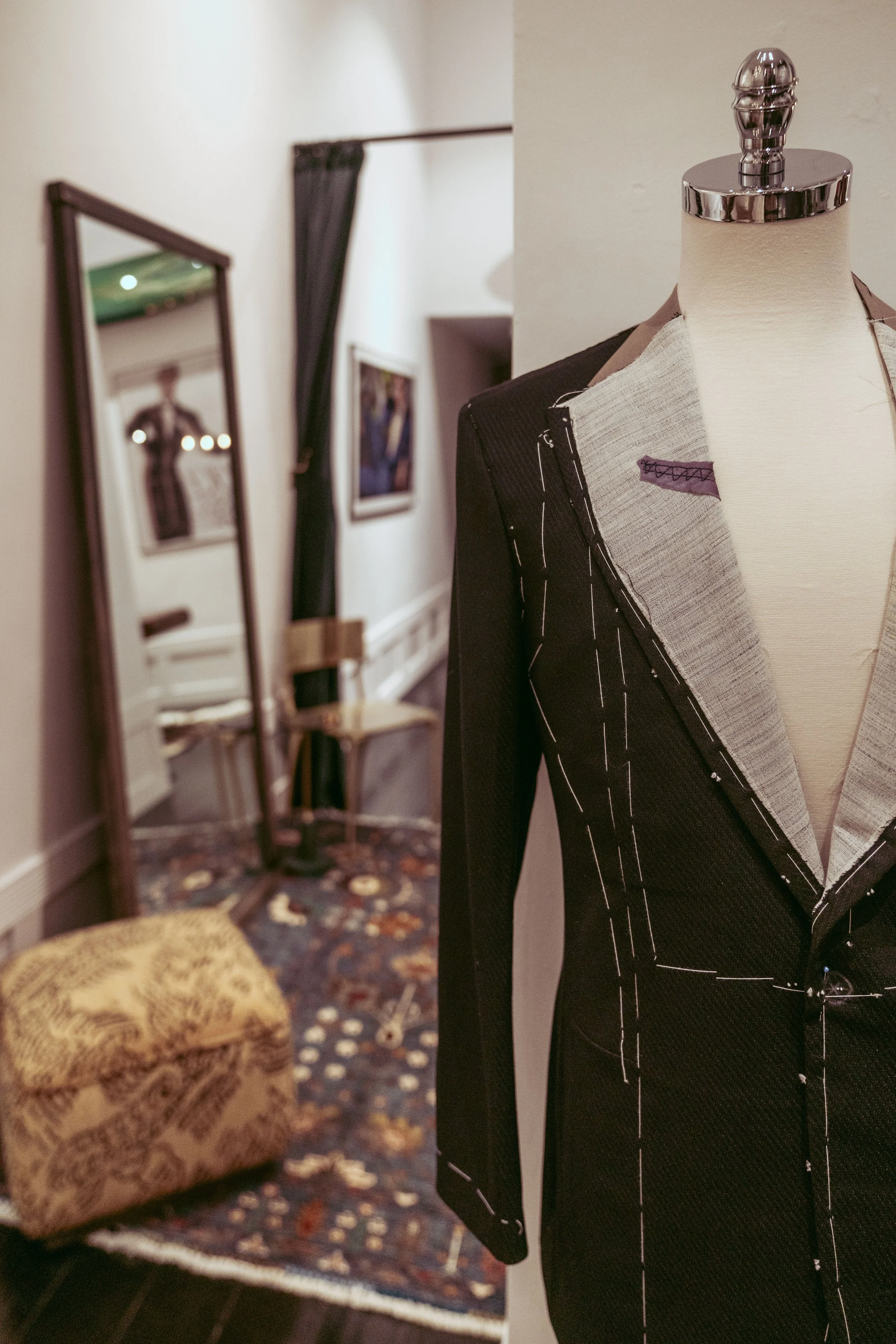
FULLY CANVASSED
A jacket in progress at the Scarborough showroom. The canvas beneath the cloth is what shapes the chest and lapel, and every semi-bespoke or bespoke jacket is fully canvassed.
How the fittings work
Both start the same way. Your first appointment is about an hour with Christian at the Post Street showroom. He takes your measurements himself, looks at your proportion and posture, and you choose the cloth and details together. That is your first fitting.
Semi-bespoke: A pattern is drawn for you from those measurements. The suit is made fully canvassed and hand finished. Your second fitting is with that hand-finished suit, so Christian can see it on you and refine it.
Bespoke: Your second fitting is in a muslin: a test garment in plain cotton, cut from your pattern. Christian checks the balance, the shoulder and the proportions, and the pattern is corrected before your cloth is cut. Your third fitting is with the suit itself, made entirely by hand.
The muslin is the real difference. Problems are solved in cotton, not in your cloth. That matters most with a particular fitting need, or a rare length of cloth where there is no second chance to cut it.
What both can do
Choosing semi-bespoke doesn’t limit the design. “We can make anything with either process,” Christian says. Lapels, buttons, linings, pockets and silhouette are open with both. The real difference is the muslin fitting and the amount of handwork.
Why custom over a good ready-to-wear suit?
“With custom, you get a much better fit, unique to you. You choose the style of jacket, whether it’s a peak lapel or a notch lapel, one, two or three buttons, and you choose the lining, the buttons and the fit we work toward. With ready-to-wear, you can only buy what they have, and there’s limited ability to get a good fit.”
Fit matters most when your build isn’t standard. “I recently had a client with very sloping shoulders who had been trying on suits at a high-end department store in San Francisco,” Christian says. “In the photos he showed me, the chest was completely collapsing. That’s something you can’t fix off the rack. We take posture and shoulder measurements so we can create a proper shoulder pattern, and the jacket fits the way it should.”
At a glance
| Semi-bespoke | Bespoke | |
|---|---|---|
| Pattern | Drawn for you from your measurements, proportion and posture | The same individual pattern, refined in a muslin before your cloth is cut |
| Fittings | Two: at your first appointment, then with the hand-finished suit | Three: at your first appointment, in a muslin, then with the suit |
| Construction | Fully canvassed, hand finished | Made entirely by hand |
| Typical turnaround | About 6 to 8 weeks | About 8 to 10 weeks |
| Wedding suit or tuxedo | Allow at least 10 weeks | Allow at least 12 weeks |
| Rush | Three weeks, when the schedule allows, for an additional charge | Not available |
| Suits from | $2,200 | $3,200 |
| Design choices | Lapels, buttons, linings, pockets and silhouette | The same |
Made-to-measure, an existing pattern adjusted to your measurements, is used only for casual pieces such as knitwear and bomber jackets. Scarborough suits are always semi-bespoke or bespoke.
Timing for a wedding or a date
For a wedding, allow at least 10 weeks for semi-bespoke and 12 for bespoke, from your first appointment to the day. For a Saturday wedding on September 4, that means a first appointment by June 26 for semi-bespoke, or by June 12 for bespoke.
Wedding suits and tuxedos start at $2,450. Christian can make suits for the whole wedding party, groomsmen and fathers included, and out-of-town groomsmen can meet him over Zoom and send their measurements.
For semi-bespoke, a three-week rush is sometimes possible, subject to availability and for an additional charge. Bespoke has no rush option. Plan on the full time if you can.
Which one is right for you?
The right choice depends less on the label than on how you will wear the suit and how particular your fit is. If ready-to-wear has never quite fit, a pattern of your own is the biggest step up, and most Scarborough suits are semi-bespoke.
If you have a particular fitting need, have chosen a rare cloth, or want the most considered result, the muslin stage is worth the extra weeks.
You do not need to decide before you arrive. At your first appointment, Christian asks how you dress, what the suit is for and what has not worked for you before, then recommends the approach that makes sense.
Common questions
Is a semi-bespoke suit cut from my own pattern? Yes. At Scarborough every suit, semi-bespoke or bespoke, is cut from a pattern made for you, and later orders build on it.
Does Scarborough make made-to-measure suits? No. Made-to-measure is used only for casual pieces such as knitwear and bomber jackets. Suits are always semi-bespoke or bespoke.
How long does a bespoke suit take? About 8 to 10 weeks. For a wedding, allow at least 12 weeks, so there is time for any final adjustments before the day.
How much does a custom suit cost? Semi-bespoke suits start at $2,200 and bespoke suits at $3,200. Payment is in full when the order is placed.
How should I compare tailors? Ask whether the pattern is drawn for you or adjusted from a standard block, how many fittings are included, and whether you will see the suit in a test garment before your cloth is cut. These three questions to ask your suit tailor go further.