
3 Questions to Ask your suit tailor
A good custom suit starts well before measurements are taken. The first conversation with a tailor should tell you quite a bit about how he works, what he pays attention to and whether his approach makes sense for the way you actually dress.
There are plenty of questions you can ask about lapels, buttons and linings. These three matter more.
1. How do you approach fit?
There is no single correct silhouette for every man.
Some people look better with a little more room through the jacket and trouser. Others suit something cleaner and closer to the body. Posture, proportion and the way someone moves all affect how a garment should be shaped.
So rather than asking whether a tailor makes a “slim fit” or a “classic fit,” ask how he decides what the suit should look like on you.
A good answer should go beyond taking a series of measurements. The tailor should be looking at shoulder line, balance, jacket length, trouser proportion and how all of those elements work together.
It is also worth talking about what you already own. Bring a jacket you love, or one you never wear. Both can be useful. Understanding why something works, or doesn’t, gives the tailor a much better starting point than measurements alone.
At Scarborough, Christian begins with the client rather than a predetermined house silhouette. The proportions are worked out around the individual and what he wants from the garment.
2. Which cloth makes sense for how I’ll actually wear the suit?
It is easy to get distracted by a beautiful fabric book.
The better question is whether the cloth makes sense for the life the suit is going to have.
A suit worn regularly for business in San Francisco has different requirements from one being made for a summer wedding, frequent travel or occasional evening wear. Weight, weave, durability, drape and season all matter.
Tell your tailor where you expect to wear the garment and how often. If you travel frequently, say so. If you run warm, say so. If this needs to become the suit you reach for repeatedly rather than something reserved for a few occasions each year, that matters too.
The most expensive or unusual cloth is not automatically the right cloth.
Christian works through the options with the client based on the garment, season and how it will be worn. Scarborough’s cloth library includes suiting, jacketing, shirting and formalwear fabrics from a wide range of mills, but the point is not simply to offer more choices. It is to narrow them down to the ones that make sense.
3. What actually happens after I place the order?
This may be the most useful question of the three.
“Custom,” “made-to-measure,” “semi-bespoke” and “bespoke” are not always used consistently from one tailor to another. Rather than relying on the terminology alone, ask what the process actually involves.
Is an individual pattern created? How many fittings are included? Is there a test garment? What happens if the finished suit needs an adjustment? Who handles those adjustments? And how long does the entire process normally take?
Those answers tell you much more than the label attached to the service.
At Scarborough, both semi-bespoke and bespoke begin with an individual pattern created for the client. Semi-bespoke involves two fittings, while bespoke includes three. For a bespoke commission, a muslin test garment is made for the second fitting so Christian can evaluate the fit, balance and proportions and refine the pattern before the selected cloth is cut.
When the finished garment arrives, Christian evaluates it on the client and identifies any final adjustments that may be needed.
A standard custom suit typically takes about six to eight weeks, so if the garment is for a wedding, event or specific date, that should be part of the conversation from the beginning.
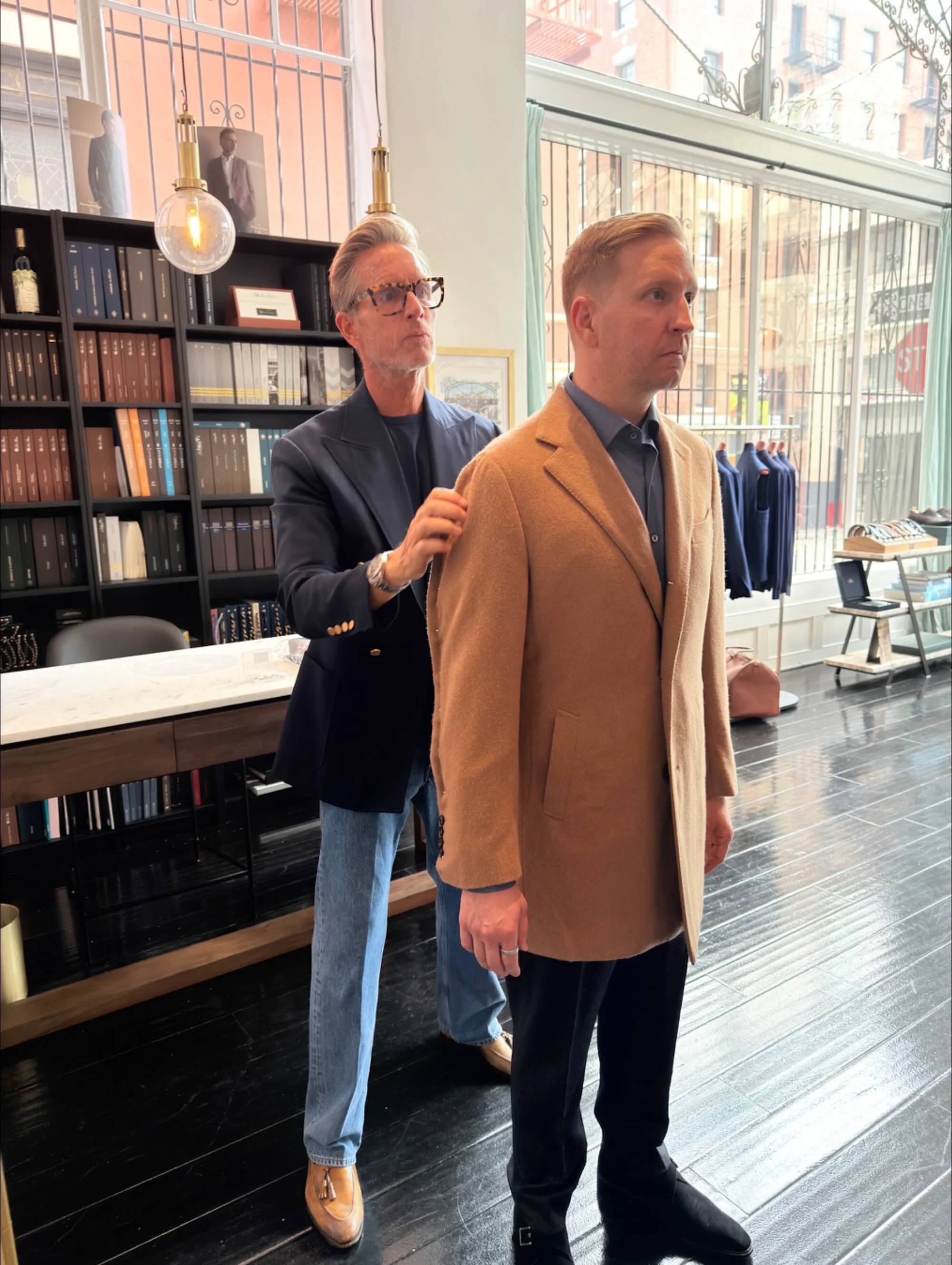
The final adjustments
Christian pins the sleeve of a client's camel coat during a fitting at the Post Street showroom, refining the fit before the garment is finished.
The right questions make the process easier
You do not need to arrive at a tailoring appointment knowing exactly which cloth, lapel or trouser shape you want.
In fact, that is part of the reason to work with a good suit tailor in the first place.
Come knowing how you intend to wear the garment, what you like, what has not worked for you before and how you want to feel in it. The rest can be worked out from there.